Showing posts with label natural fertilizers. Show all posts

Saturday, March 7, 2015

Getting better yields from a vegetable garden

With the change in the morning and evening temperatures signalling autumn, my mind is once again turned to planning for the new season’s crops.

To be totally honest, summer harvests have been disappointing and because of my lack of time I certainly have not made the most of what we did get from the garden.

As I do a mental tally of what we have eaten or stored from the vegetable garden it really is not boast-able.


We had a poor marrow crop this year compared to last, our first two plantings of corn failed, our tomatoes yielded some fresh for salads but most had to be roasted for pasta sauce and that quantity was only about 4x 1 liter bags. Herbs we have had a plenty and chilies too…but a girl & her Superman can only eat so many chilies!

Salad leaves have kept us in good supply while we had hardly any asparagus due to a slight misunderstanding. Not one cucumber showed up for the party, which is simply rude! We had two – yes TWO – butternuts come out to play and no pumpkins.

In my experiment beds all the carrots and turnips came up, but it was too early for turnips so they went to seed. So all in all, I am a bit frustrated and saddened but I can truly lay the blame at my door.

Please see this as a personal therapy post…I need to vent a little. (At myself mostly!)


I am however one of those people who do not beat themselves up for long – just a good tongue lashing in the mirror and then its time to move on. I have therefore been doing some research – which is partly to get my mind in the right mode and partly to increase my knowledge – on how to get the vegetable garden to yield more.

Here follows my decisions….

Motivation

Yup – the first thing to deal with is my own motivation. Even though we cut back on much superfluous stuff over the last few months, I am still a busy woman. But there are times when I could go out to the veggie garden or make newspaper pots for new seedling, but I don’t. I ignore that and do something else – also good, also worthwhile but not what will feed into the greater goal of growing more vegetables. 

So I need to deal with me. 

I’ll go and do that then...

Soil

I have noticed for a while now that my beans and corn have a yellow tinge to them, especially the ones in our newer section of the garden. This means that there is not enough nitrogen for them to stay nice and green. Growing vegetables organically means that I need to continually add manure, worm casing or blood meal. I have struggled to find blood meal in SA and I would only want it from an organic source anyway. So it is horse manure from a friend’s stable and our own worm casings and tea.


I also need to add topsoil as some of my beds have sunk way below the raised bed level. I have sourced topsoil, into which we will add our own compost and horse manure.

Because the winter vegetables, like broccoli, that I will be putting in shortly need a dose of fishmeal too into those beds. Later in the season I will add some Bounce Back pellets to all beds.


The soil is the starting place for all good vegetables. I have learned that you cannot save on compost hoping to get good yields. My compost is a bit slow to turn over at the moment because we haven’t had rain for a while, and I have forgotten to water the heap, but just yesterday we emptied the cages and added it back in layers alternating with leaves, manure and existing compost from the heap. A good watering once a week and covering it should have it ready by the end of March.

As the Stinkwood tree, which dominates our front garden, starts to drop it's leaves I am going to get Sam to make leaf mould. This will be a great mulch for summer days next year.

Spacing

With the quality of the soil boosted I am going to plant my plants much closer together. I have always tried to follow the given instruction but most of the time those spacing guidelines are for the absolute maximum size of the ready to harvest veg. We tend to eat our vegetables smaller than larger so I am going to halve the spacing requirements when I sow the seed and see how it goes.


Vertical

In addition to closer spacing I am going to keep experimenting with vertical growing. Unfortunately all the climbing and running veg come to an end in summer, except for peas. The peas will use the cucumber frame that we built last year and I will probably make another one for elsewhere in the garden.

I have a large expanse of wall that I am quiet keen on using as the backdrop to an espalier apple tree. I will be doing some research on this and then seeing what comes of it.


Water

Watering may be a challenge in summer because of adding more plants to the beds than before. Here in winter we have plenty of rain and I generally do not need to water at all.

I really really really (Hey Superman do you get the hint) want to get an irrigation system installed. It doesn’t need to be on a timer, it needs to just have a simple black piping around the edge of the beds with some low sprinkler heads that I can plug the hose from the borehole into instead of dragging the hose and the sprinkler around for two days to water the whole garden.

I think it will also waste less and help with the water pressure issues we have.

Fruit

We have two apple trees, two avocado trees, a bramble for berries, a prolific fig tree, two lemon trees and two orange trees, two grape vines and loads of Cape Gooseberry plants. Our strawberries are grown in baskets and are now sending out their runners. Despite this we only had enough strawberries this year for one batch of jam and some fresh each day for breakfast. 


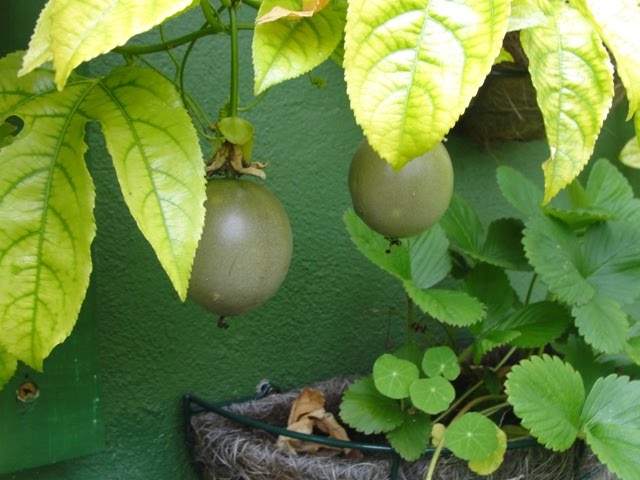
We also have a splendid granadilla vine which really comes in this year as our winner producer. It makes me smile every time I walk in from the carport as it trails its way over the gate.


Our figs were used in jam, preserves and ice cream, our apple and orange trees are new, but our lemon trees give is a few lemons each season. Our avocados trees gave us their first few fruits this year after being in the ground for 6 and 4 years.

Companion planting

I dabble with this all the time and what I actually enjoy most is the variety and colors that companion planting gives to the vegetable beds. It is also a way for me to bring flowers into the garden, which the pollinators need. It may not directly increase the yields but companion planting does keep the bugs down (…down – not gone – as this utopia I have not yet found!)

Pollinators

I recently connected again with a friend’s brother who is an urban beekeeper. This movement of homing bees on top of garage roves is taking the world by storm and its hitting South Africa too.

Slight problem…

I am very allergic. Mmmh.

But this beekeeper will install two hives here for me and maintain them, collect the honey and everything for me.

This means that our garden will have more bees, which I have battled to attract for all the years we have grown veggies.

I have tasted his honey too and it’s like toffee…supremely delicious. I guess you can tell which way I am leaning.

All that I am waiting for is to get municipal confirmation that we are indeed able to be part of this movement. 

Excited!!!!

So there is the big plan. Looks so good and simple on the page, but there is a Rands and Cents as well as time cost to calculate.


I think I had better go and make myself a Red Latte and contemplate the future here on our little patch of Earth and how we can implement all my plans.

Thanks for reading and I do hope you are inspired to increase your garden yields this year too.

Sunday, January 19, 2014

As summer rolls along

Sunflowers at the back gate


With summer comes the veggie pests and diseases, but when I walk through my garden and grasshoppers jump out the way, dragonflies and other friendly flying creatures flit in front of me and I see the ladybugs who sit on the leaves of the plants, I know that I have a garden that is a happy place for them.
Sweet potatoes
I suppose I could use sprays so that I get all the veggies, but I am happy that not only do I get "clean" food for my family, I also provide a place that friendly bugs like to visit. You see, those sprays don't just kill the bad bugs they also wipe out the beneficial ones.  Uuh-huh!

So my modus operandi these past few seasons is to leave some plants for the bugs to enjoy. Nasturtiums were planted along with the brassicas in winter and were a good decoy for the white cabbage moth to lay her eggs on. Her little babies munched away happily and got nice and fat then disappeared.

My cauliflowers, broccolis and kale all went unaffected by them for the most of the season and only one of the few kale plants that were left at the end of the season had any trouble. Even then I left the bugs on the kale and they too eventually left for other pastures, leaving the plant to continue supplying us with leaves to eat.

Harvesting is continuing with loads of marrows still coming in - in fact today I sent out an "SOS come get a marrow" text to 4 friends so that I can unload the last of these monsters. I planted way too many of them this year and will probably only plant 5 as versus 20 (what was I thinking???) next summer.

Today's tomato harvest
The tomatoes, even though they got blight, have reached the beautiful red stage. We have brought in about 20 kgs of them so far and turned them into sauce & eaten them fresh. The Italian sauce tomatoes are so lovely when roasted with herbs and garlic then blended.

Our first batch of corn was a complete failure, but our second planting has yielded some good corn. As a friend pointed out to me, the leaves of the plants are more yellow-green than green-green which indicates a lack of nitrogen in the soil. I did not add any manure in this bed as the last batch of manure brought so many weeds with it that I could not face all that weeding again. I am going to have to investigate alternatives for adding more nitrogenous matter to the soil which will not add weeds along with the nitrogen.

While it is so good to have a break from the hard work of digging in compost, making seed pots and getting seedlings started and growing well, I cannot ignore the fact that there are 6 more weeks until I need to have a plan in place and seeds sown for my late summer early autumn vegetable gardens. So this afternoon I plan to plan! We will see if I get to that.

I have been churning over ideas in my brain for a herb garden in what we call "Zeus's sandpit." This area has been a vegetable garden, a grassed area and now is where Zeus digs and runs and is simply a mess. I recently laid out some paving stones in his running track and he simply moved his run to the right of them.
Sweet lemon cucumbers

He gets 4 long walks a week in the forest and all other things that dogs need like bones to chew, grooming, swims on hot days and lots of love and he has another small digging patch at the back gate so I am afraid that his time in the sandpit is almost up.

When I have the plan in a more concrete way I will let you know what I am planting and why. I have wanted to grow more herbs for culinary purposes and also educate myself more on medicinal herbs that I can grow and use easily. "Easily" is the keyword here as time does not allow me to go into this too deeply yet.

I suppose this is the limbo period where I find myself right now...the harvests coming in, enjoying the meals, watching plants handle the heat and pests - or not - and planning for the next season.

One of the 5 pumpkins - just enough for a year :)

What are you doing for and with your garden right now?

Saturday, August 14, 2010

Caring for perennial Vegetables

I have spent some time this week reading up on how to care for my perennial vegetables, fruit vines and berry canes. My gardening books all talk about adding 2:3:2 and 3:1:5 but as we have successfully managed, for the most part, to grow and feed our veggies organically, I needed to "read between the lines" and see what I could find from natural sources.

These are my perennials that need some TLC at the moment, photos were form last season.

Grape Vine ~ Strawberries ~ Blue Berry ~ Black Berry ~ Lemon and Orange Tree ~ Olive Tree ~ Granadilla Vine ~ Rhubarb ~ Asparagus

I started with the simplest - rhubarb. Our chickens have enjoyed eating all the winter leaves off my humble rhubarb. So yesterday we decided to uproot the 4 plants and put them into a side patch in the fenced garden so that they can yield again in summer. These just needed some compost and water and a replanting.

My asparagus is still in the trailer park and Superman and I are debating their permanent position. Yesterday we trimmed off all the dead fronds and fed them some worm juice. More on worm juice in a moment. In the next two months we need to have them planted in their permanent position.

Our grape vine is still bare, new leaves should appear in about 3 - 4 weeks time. It's time to start watering it with a slow trickle of a hose. It will also enjoy a nitrogen feed about now.


The granadilla vine needs nitrogen now too, as well as some epsom salts. A natural source of potassium like wood ash, or volcanic ash is also a good feed right now. Tomorrow Superman and son are going to make upside down L-shaped brackets so that we can train the vine to grow forwards and the fruit can hand down. At the moment it is trying to lace itself into our electric fence which cause the poor thing to get fried!


For my black berry plant, I was told to feed it a banana smoothie as the flowers start to show. Bananas are high in potassium so when you have over ripe bananas, blend them up, skin and all, and place it around the base of the plant.


Blueberries need an acidic soil and peat moss is the best source for this, unfortunely using peat does not = green gardening. Peat beds are being dug up at a rate faster than it can replesnish istself, so it is best to stear clear of using it in your garden. A great organic substitute is Rooibos mulch or going for a walk in a pine forest and collected some needles. These can just be used around the base of the plant and the acidic residue will leech through to the roots.


Yesterday we repotted our strawberry plants that we grew from the parent plants. We have another 10 or so plants now for this coming season. All fruit plants benefit from SEAGRO or LIQUI-nure. This is where the worm juice comes in. Worm juice is very high in nitrogen and other nutrients. I dilute mine 1 to 10 and feed to my hanging baskets at least once a month. But in the height of summer we don't get enough juice so I do buy liquid feed.

I am toying with the idea of making some KELP TEA as this also is full of wonderful nutrients for my garden.


My olive and citrus tree need to be replanted. They are in big wine barrels at the moment and as soon as we have done our big clear out in the last part of the garden, we will transplant them there.


In my reading I saw that BAT GUANO is brilliant for promoting flowers on fruit trees, so I am going to have to source some of it somewhere....mmmh!?!